



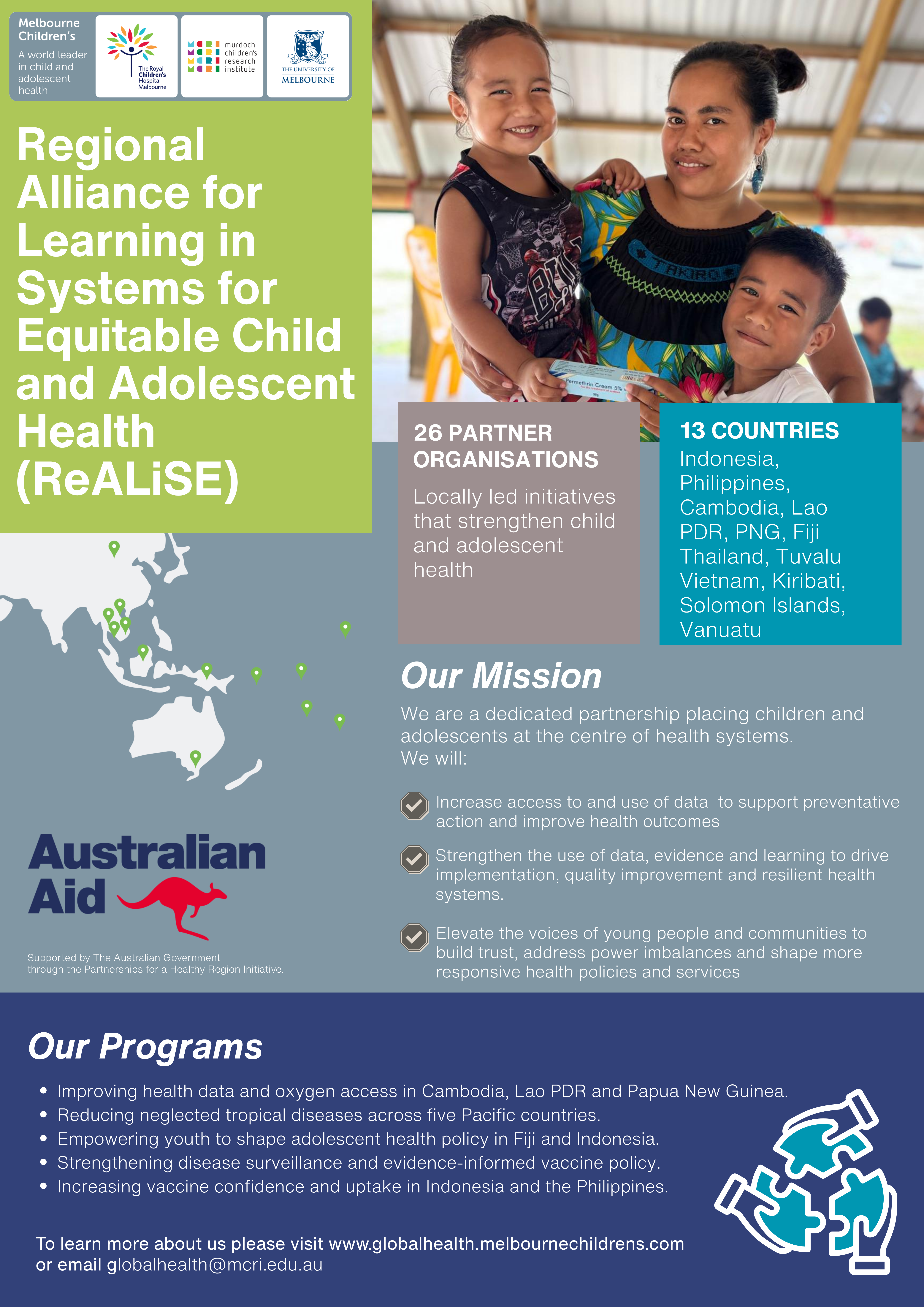
Regional Alliance for Learning in Systems for Equitable Child and Adolescent Health (ReALiSE)
Our Projects

Adolescent Non-Communicable Diseases
Preventing Non-Communicable Diseases in Adolescents in Indonesia
Typhoid STEVIA Vaccine
Generating stronger evidence on the prevalence of typhoid fever among patients admitted to hospital in Indonesia.
Vaccine Uptake - Vaccine Champions Program
Social and behavioural research into vaccine uptake, vaccine resource development, and a vaccine education and communication training program.
VaxPulse - Vaccine Safety
Using AI and large online data to dynamically track vaccine myths and concerns online, to support doctors and communities in staying ahead with clear trustworthy facts.

Adolescent Non-Communicable Disease
Preventing Non-Communicable Diseases in Adolescents in Fiji
GpB Strep Vaccine
World Scabies Program
Reducing the impact of scabies of children and communities.

Vaccine Champions
Increasing vaccine demand in Asia and the Pacific
VaxPulse
Using AI and large online data to dynamically track vaccine myths and concerns online, to support doctors and communities in staying ahead with clear, trustworthy facts.

REAL-MOXY
Working with health facilities to understand how oxygen care is delivered, identify challenges and opportunities, and improve emergency and hospital care for children.

Stronger Systems for Child Health in Lao PDR
Working with the Lao Pediatric Association (LPA) and the Lao PDR Ministry of Health to improve care for children, by strengthening child death review systems to turn data into action.
ARIVI
Improving the management and prevention of acute respiratory infections in Lao PDR through enhanced diagnostic capacity and generation of high‑quality evidence on acute respiratory infections (ARIs) epidemiology and aetiology to provide actionable evidence to the Ministry of Health to inform national policies on ARI diagnosis, treatment, and prevention.
Vaccine NITAG
Supporting Lao PDR's immunisation policy through capacity building and a learning health systems approach.

Child Health Capacity
Strengthening capacity among the paediatricians, trainees, and paediatric nurses in PNG.

Vaccine Modelling PCV 1+1
This observational study aims to describe immune responses to PCV13 in children recovering from measles infection at different periods of post-infection and in healthy children who have not had measles infection in the past six months. All children have not received any PCV doses.

PVC13 Measles Vaccine
This observational study aims to describe immune responses to PCV13 in children recovering from measles infection at different periods of post-infection and in healthy children who had known not to have measles infection in the past six months. All children have not previously received any PCV doses.



World Scabies Program
Reducing the impact of scabies on children and communities.

Asia-Pacific Vaccine Research Network
Increasing vaccine research capability for immunisation policy decision-making